
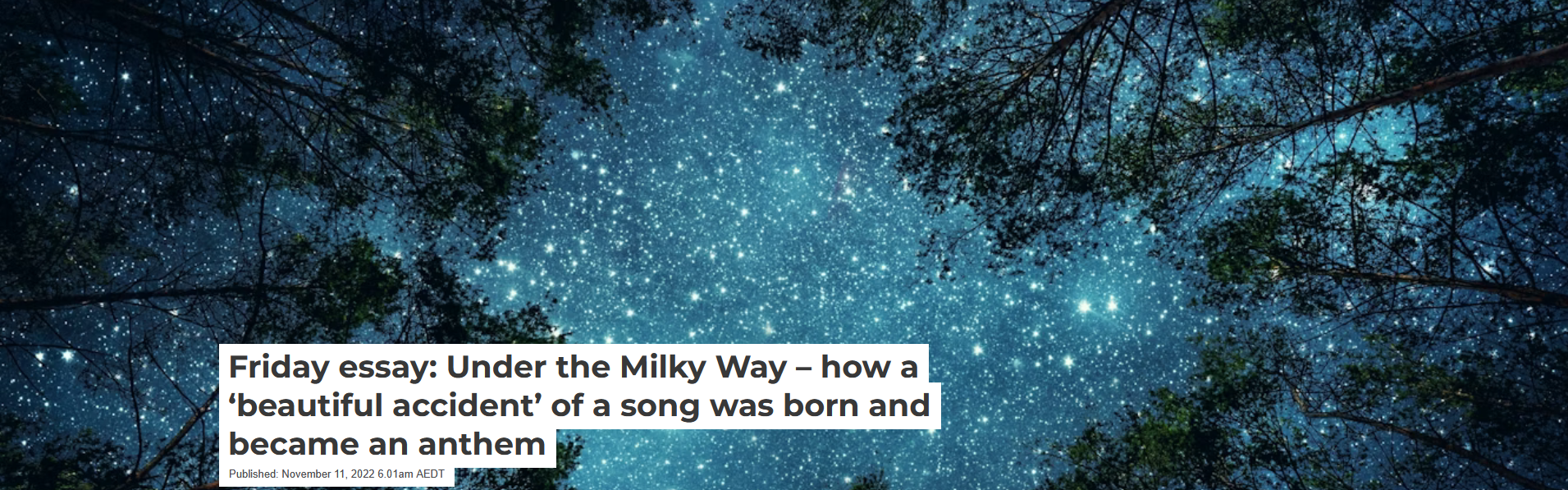
Under the Milky Way — Inspired at Smiths Lake
How a quiet evening at a mother's lakeside home on the NSW Mid-North Coast gave rise to one of Australia's most enduring songs — and why Smiths Lake holds a permanent place in the story of The Church.
Smiths Lake, NSW Mid-North Coast, Australia — A languid tidal inlet flanked by gentle slopes, roughly three hours north of Sydney. Steve Kilbey's mother lived across from the inlet, with views over the water and a backyard cabin that housed an old, slightly out-of-tune piano.
The story
In 1986, Steve Kilbey — lead singer and bassist of Sydney alternative rock band The Church — visited his mother at her home beside Smiths Lake with his then-partner, Swedish musician Karin Jansson. It was an ordinary evening after dinner, in an unremarkable lakeside setting. What followed was anything but ordinary.
"There were birds and flowers and snakes. She had a big deck you could sit on and see the sea." — Steve Kilbey, describing his mother's home at Smiths Lake
After the meal, Kilbey slipped outside, smoked a joint, and wandered into the backyard cabin. There sat an old upright piano — slightly out of tune, with childhood toys belonging to his brothers resting on top. He sat down and began to play, starting with a simple A-minor chord.
"Being stoned, I could hear a world of possibilities in that chord. Gee, the second chord sounds good… on the bass note is a f—ing F-sharp! The whole thing may have taken a minute. My chord progression fell out of the sky." — Steve Kilbey
Karin Jansson joined him, and together they assembled the lyrics in a stream-of-consciousness session that lasted only minutes. The song was essentially complete before the night was over. Kilbey filed it away as "just another song" — he was writing four or five songs a week at the time — and thought little more of it.
The title's other origin
While the music was born at Smiths Lake, the song's title draws from a separate source of inspiration. During his time in Amsterdam, Kilbey had frequented the Melkweg — a celebrated music and cultural venue whose name is the Dutch word for ‘Milky Way.’ The two threads — a night under southern stars on the NSW coast and the memory of a beloved Amsterdam venue — wove together into the song's identity.
A note on inspiration
Kilbey has offered a characteristically wry account of what actually motivated him to sit at the piano that night. Rather than a grand artistic impulse, he has suggested the real driver was a desire to avoid doing the dishes — reasoning that if he retreated to the cabin, Karin would stay inside talking with his mother, and the washing-up would take care of itself. One of Australia's greatest songs was, by some accounts, born from a desire to skip the housework.
From Smiths Lake to the world — a timeline
1986 — Smiths Lake, NSW: Song composed Kilbey and Jansson write the song spontaneously one evening at his mother's home beside the lake. Kilbey records a rough demo on a home eight-track recorder — bass and acoustic guitar only — and sets it aside.
1987 — Los Angeles, California: Recorded at The Complex The Church travel to LA to record their fifth studio album, Starfish, with producers Waddy Wachtel and Greg Ladanyi. Neither the producers nor most band members were enthusiastic about the song, so Kilbey recorded it separately in a small studio within The Complex. The cassette demo was loaded into a Synclavier — the most advanced music workstation of the era — and transformed into its final, shimmering form. Session drummer Russ Kunkel was brought in after the original drum track proved unsatisfactory.
15 February 1988: Released as a single The song is released simultaneously on 7" and 12" vinyl by Arista Records internationally and Mushroom Records in Australia, alongside the Starfish album. It reaches No. 22 on the Australian Kent Music Report Singles Chart and No. 24 on the US Billboard Hot 100.
1989 — ARIA Music Awards: Single of the Year The song wins Single of the Year at the ARIA Music Awards — though Kilbey, characteristically, declined to attend the ceremony to collect the award.
2001 and beyond: A life of its own Featured on the Donnie Darko soundtrack, performed with the Melbourne Symphony Orchestra at the 2006 Commonwealth Games opening ceremony, and voted the best Australian song of the past 20 years by readers of The Weekend Australian Magazine in 2008. Covered by hundreds of artists worldwide, it remains Australia's unofficial anthem of the night sky.
"It's an accidental song I accidentally wrote, that accidentally became a single and accidentally became a hit." — Steve Kilbey, 2011
Sources: The Conversation https://theconversation.com/friday-essay-under-the-milky-way-how-a-beautiful-accident-of-a-song-was-born-and-became-an-anthem-193095 · Wikipedia — Under the Milky Way https://en.wikipedia.org/wiki/Under_the_Milky_Way · PopMatters https://www.popmatters.com/church-under-the-milky-way · Norseland's Rock https://norselandsrock.com/under-the-milky-way-church/ · Red Bull Music Academy https://daily.redbullmusicacademy.com/2016/08/the-church-s-steve-kilbey-on-the-strange-second-life-of-under-the-milky-way/. Content compiled for Villagefirst.